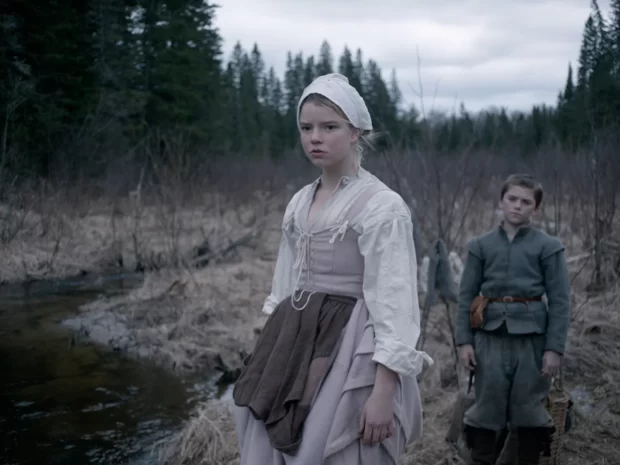
The Witch came out in 2015, nearly a decade before this writing. This makes it a relatively new entry in the swath of films based in colonial America, and its lack of true historical relevance made it somewhat of a gamble to produce. It was difficult, Eggers says, “convincing financiers that a pilgrim horror movie in Jacobean English was going to be something that people wanted to see.” [1] The popularity of historical fiction waxes and wanes like any other trend, but the fact that a movie of this type was able to be made speaks to the current climate with regards to mainstream acceptance of more artistic horror films.
The Witch was also immensely successful, grossing $40 million on a $4 million budget and winning a Best Director award at the Sundance film festival where it premiered. [2] It would seem that such a movie was something that people wanted to see, and perhaps that was a consequence of it being based on a cultural fear that has been talked about a hundred times before in a hundred different ways. Movies about famous accused witches have been made. Movies attempting to tell the story of the Salem Witch Trials have been made. But The Witch eschews any and all particulars of historical people and events to create something both more artistically-inclined and more personal. It’s incredible simplicity allows it to tell a story that manages to be timeless whilst being rooted in a very particular time and place, which is a very different approach than most historical fiction tends to take. In more recent years, especially as recent as nine years ago, we have seen some of these more experimental takes on straightforward history that have resulted from people trying to find a new way to tell a story that has already been told.
On Sexuality
A particular aspect of the film that is touched on only briefly is the concept of sexuality, specifically with regards to Thomasin, the eldest daughter. She is perceived as a sexual object by her younger brother, Caleb, with several shots following Caleb’s eyeline as he stares at Thomasin’s chest. Later in the film, when everything is falling apart and everyone but Katherine and Thomasin have died, Katherine attacks Thomasin, calling her a “slut” and accusing her of tempting her brother and father into sex. Open sexuality was often one of the accusations levied toward a witch, as witchcraft as a whole was generally considered to be an extreme manifestation of women’s worst desires. [3] The female soul was considered to be more passive, more gentle, and more open: therefore, more likely to fall for Satan’s guile through their weakness. [4] In modern times, there have been an extensive number of “reimaginings” of the Salem Witch Trials and of historical witchcraft as a whole — some stories, like Harry Potter, feature witches as heroes. Others, such as Netflix’s Fear Street movies, portray them as sympathetic villains. Much of today’s treatment of witches, however, approaches their accusation and trial through a modern feminist-influenced lens, and The Witch is no different.
Though it’s a minor event, and I would not argue that The Witch is trying to make any particular statements with regard to feminism and sexuality, the fact that Thomasin is accused of sexual impropriety so viciously by her own mother is a distinctly contemporary touch. It is clear to the viewer throughout the film that Thomasin is simply being objectified by her brother, if anything, yet she’s the one being blamed for it. Such an angle does not feel accidental, especially when the movie was released a mere two years before the social atmosphere surrounding rape culture reached a boiling point with the #MeToo movement.
Conclusion
As a whole, The Witch’s abstract, insular examination of early modern American conceptions of witchcraft works very well in demonstrating the attitudes and perceptions Puritans at the time would have held. It cannot be used as a source of information on any specific people or places, but it isn’t trying to be. The point of The Witch is to create a sort of everyman family within the framework of the Puritanical belief system, and it takes great pains to do so as accurately as possible. The resulting work is, though harboring a few known flaws, a very valuable portrayal of what life may have been like for the viewer, had they lived in that place at that time. It tells a story that, in the eyes of the characters themselves, is a realistic tragedy that could have befallen anyone. [5] Watching the movie makes the viewer feel that way as well, an impressive feat for a film portraying a lifestyle so far and away from anything a modern audience would have experienced. The attention to detail and resulting level of immersion equate to a viewing experience that feels, in some ways, more educational than would have a direct adaptation of a real accused witch’s life.
[1] Stephen Saito, “Persistence of Vision: Inside the Making of the Witch, a Horror Classic for the Ages”, MovieMaker, January 31, 2023.
[2] Maria Norris, “10 Things You Never Knew About the Making of ‘The Witch.’” ScreenRant, December 25, 2020.
[3] Isaac Reed, “Why Salem Made Sense: Culture, Gender, and the Puritan Persecution of Witchcraft.” Cultural Sociology 1, no. 2 (2007), p. 223.
[4] Elizabeth Reis, “The Devil, the Body, and the Feminine Soul in Puritan New England.” The Journal of American History (Bloomington, Ind.) 82, no. 1 (1995), p. 16.
[5] Jason Herbert, “The Witch with Mikki Brock”. Historians at the Movies, July 19, 2023.