Background
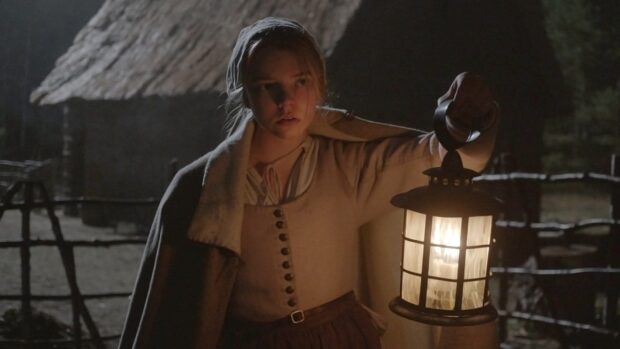
The setting of The Witch is somewhat nebulous – we are not given an exact year, nor an exact location. As viewers, we know that we are sometime in the 1630s, somewhere in New England. We follow entirely fictional characters within this vague snapshot. Thomasin and her family are somewhat based on a story Eggers unearthed about a real Yorkshire family who traveled to Massachusetts with the Pilgrims, then struck out on their own when they could not reconcile their religious differences [2]. The characters themselves did not exist, however, merely layered atop this existing history as an example of one thing that might have happened. This is a decision that certainly makes filmmaking easier, as it eliminates concerns about getting the details of particular historical figures and their lives just right. It is also a wise choice to tell a scary story, as more vaguely-defined everyman characters can make the viewer feel more easily able to relate to the horrors they’re going through. In order to tell this story at all, however, the setting those everyman characters exist in needs to feel real in its own right. In this endeavor, Eggers found historical accuracy to be a necessity, saying that he “needed the world to be grounded in order for the supernatural stuff to actually be believable.” [1]
Linguistics
All dialogue in the movie is conveyed in language that is as period-accurate as possible, with Eggers noting that “we had various historians give the thumbs-up to the language, but it’s definitely my interpretation.” [1] An understandable result, as a reconstruction of everyday Puritan dialogue would naturally have to be based on written sources alone. Much of it is, in fact — Eggers lifted many turns of phrase directly from publications of the day. [2] The use of a Yorkshire family as the basis for the protagonists is no accident, however. Most of the initial settlers of New England in the 1630s would have hailed from Essex and had a notably different accent than the one we hear in the film. This was Eggers’ initial plan for the family’s origins. However, when Eggers heard Ralph Ineson’s natural Yorkshire accent for the first time, he decided to further his research and rewrite the script along those lines. [7] Despite this slight deviation from the norm on Eggers’ part, the fact that such families did exist tells us that hearing such an accent in Puritan New England may not have been so unlikely.
Set Design
There was considerable effort put into the visual accuracy of the film, as well. As the main characters are a homesteading family, the set was built almost entirely on-site (in Canada, so not exactly on location) with trees felled in the surrounding forest. They used period-accurate equipment to do so, and worked according to the specifications of building manuals from the era. [1] The crew was even taught the appropriate farming techniques of the time, “just in case” the set ever needed to become a truly operational farm. While some of the details are off, such as the family’s corn being harvested in shocks when normally only the ears would have been cut, or the windows of the house being about a third larger than they should have been for lighting purposes, great pains were taken to make the setting and surroundings as accurate-to-life as they could be. [2]
Religion
Puritan religious beliefs, harsh and bleak, form the foundation of the horror in The Witch. William, the family patriarch, willingly accepts their banishment on the basis of his idealogical differences with the religious heads of the Puritan settlement. He calls them “false Christians”, and feels that his family would be better off striking out on their own in the wilderness with their, ostensibly correct, interpretation of religion. The movie showcases several conversations between the characters that do a solid job of explaining to the audience what it is these people believe and how those beliefs impact their psyches and relationships with one another. Most notable is a conversation between William and his son, Caleb, after Caleb’s infant brother Samuel is taken and killed by a witch. William has Caleb recite part of a catechism by John Cotton, called Spiritual Milk for Boston Babes in Either England. This was published a decade after the movie is set, but it was a foundational text for Puritan children at the time, and opens with the insistence that all people are made in sin and have the nature of sinners. [3] Then Caleb asks William if Samuel is in hell, since he must have been a sinner too, and William tells Caleb that no man can know if they are destined for heaven or hell. This is a good representation of the Puritan belief system that asserts that a person’s postmortem destination is preordained, and that if one is blessed by God, they will not suffer unduly in life. [4] It also skirts the boundaries of the issues inherent in attempting to teach Puritan philosophy, which holds fast to the contradictory ideas of the goodness of actions like work and prayer alongside the conviction that everything born of man is sinful. [5] If Samuel was just a baby — an unbaptized one at that — would he still face the same agonizing fate? According to his mother, yes, as we hear her lamenting this fact later on.
The Reality of Witchcraft
That the family in question is plagued by very real witchcraft is not hard for them to believe. Pilgrims of the 1630s had already witnessed decades worth of witch hunts happening back in England, and their presence in the New World would not have been much of a shock. [4] When Thomasin is accused by her younger siblings, Jonas and Mercy, of being a witch, there is no hesitation on her family’s part — no questioning of the existence of witches, nor the possibility that Thomasin could be one.
William immediately turns on Thomasin and asks her if the accusations are true, ready and willing to believe. This was the same sort of readiness that lead to situations like the Salem witch trials, one account of which states that “There was little occasion to prove the witchcraft, it being evident and notorious to all beholders.” The portrayal of said witchcraft also parallels the Salem accusations of violence, sexual immorality, and, notably, an attempt by the accused witch to get victims to sign their names in a book. [6]
To this Puritan family, the true terror of their experience isn’t the witchcraft itself, or even the deaths that result from it. The real trial these homesteaders must endure is the slow and terrifying realization that they may not be people of God’s favor, no matter their dedication and daily works. According to their own beliefs, they have no hope and no recourse once it has become clear that the Lord is not with them. [4]
[1] Stephen Saito, “Persistence of Vision: Inside the Making of the Witch, a Horror Classic for the Ages”, MovieMaker, January 31, 2023.
[2] Matt Patches, “The Scariest Movie at Sundance: How Robert Eggers Made the Horrifying, Historically Accurate ‘the Witch’”, Grantland, January 29, 2015.
[3] John Cotton, Spiritual Milk for Boston Babes in Either England. Samuel Green, 1646.
[4] Jason Herbert, “The Witch with Mikki Brock”. Historians at the Movies, July 19, 2023.
[5] Elisabeth Ceppi, “Invisible Labor: Puritan Servitude and the Demonic Possession of Elizabeth Knapp”. American Literature 78, no.2 (2006): 263-292.
[6] Cotton Mather, Wonders of the Invisible World. 1693.
[7] Michael Lynch, “Hearing Seventeenth-Century Colonists in ‘the Witch.’” Past in the Present, March 11, 2016.